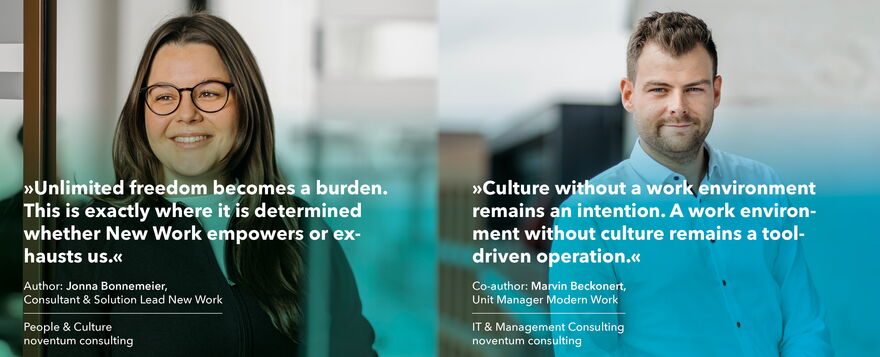
We are experiencing a period of profound upheaval that is both unsettling and opens the door to new possibilities. Technological progress, digital connectivity, and new ways of working have created opportunities to rethink work entirely: in a way that is more flexible, more self-directed, and more in tune with the realities of people’s lives. The fact that companies today are talking about purpose, mental health, and inclusion is no coincidence; rather, it is an expression of a long-overdue cultural shift.
News from information technology, current trends in the IT industry, concrete projects of noventum consulting GmbH and its partners, dedicated commentaries and interesting events from the everyday life of IT management.
Many companies are in a transitional phase: While on-premises data warehouse environments continue to deliver reliably, demands for self-service, AI capabilities, and the integration of unstructured and semi-structured data are on the rise. In the Microsoft ecosystem, SQL Server (on-premises), the Azure Data Platform, and Microsoft Fabric overlap – leading to issues such as decision-making bottlenecks, fragmented proof-of-concepts, and inconsistent skill sets.
Cloud computing is now a central component of modern enterprise IT. However, the speed and functionality offered by deeply integrated cloud services also create dependencies that are difficult to break later on. Sovereignty does not arise from isolation, but rather from conscious design. “Exit capability” describes the ability to further develop architectures, replace components, and realistically keep migration paths open. It arises from the interplay of technical openness, organizational competence, and economic clarity.
In many companies, SharePoint has long been more than just a document repository. The platform serves as a central hub for internal communication, process information, project knowledge, and collaboration. It’s where news is published, knowledge is shared, and relevant information is made available to various target audiences. However, when teams collaborate internationally, a challenge arises that quickly becomes apparent in day-to-day work: content is often available in only one language. This can lead to misunderstandings, create additional coordination efforts, or, in the worst case, result in important information not being used at all.
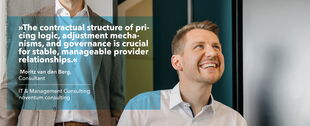
Rising operating costs, tightening budgets, and new dependencies on cloud and platform providers are changing the rules of the game in IT sourcing. What was primarily a matter of price negotiation when noventum’s sourcing consulting practice began in 1998 has now become an ongoing task: Contracts must allow for adjustments, governance models must be effective, and incentive systems determine quality, speed, and innovation. This article examines the economic mechanisms behind typical friction points in provider relationships and explains why transparency and controllability are now more important than the supposedly best price.
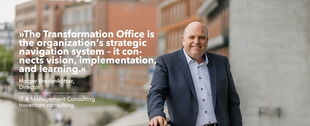
From strategic vision to real-world transformation. IT is no longer merely a support function; it shapes business models, innovation, and competitiveness. In a world marked by technological change, geopolitical uncertainty, and resource limitations, IT bears a dual responsibility: it must maintain the stability of day-to-day operations while also ensuring the company’s long-term future viability.
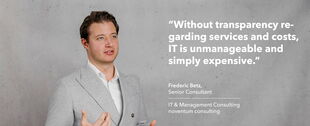
IT efficiency – that sounds like austerity measures, consolidation, and budget cuts. But anyone who thinks that way is missing the bigger picture. In a conversation with Frederic Betz, it becomes clear that this is about much more than just costs. It’s about governance, strategy, and how IT creates real value. An interview about complex decisions, knee-jerk reactions and why efficiency remains a perennial topic in the IT world.
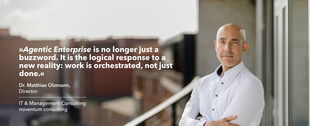
At Anthropic, AI writes 90 percent of the code for new versions of Claude. OpenAI has released GPT-5.2 Codex, its “most advanced agent-based coding model.” Salesforce is calling this the year of the “Multi-Agentic Enterprise.” What sounds like Silicon Valley hype is the new reality at leading tech companies and a wake-up call for German small and medium-sized businesses and large corporations.
The demands placed on a modern, integrated communications landscape are constantly increasing. Outdated IT systems not only slow down processes, but also increasingly impair the innovation and competitiveness of companies. Against this backdrop, HEWI Heinrich Wilke GmbH, a long-established manufacturer of high-quality sanitary systems, fittings, and barrier-free solutions, decided to replace its established Lotus Notes groupware system and make a strategic switch to Microsoft 365. Together with noventum consulting, this change was carefully prepared and successfully implemented.